

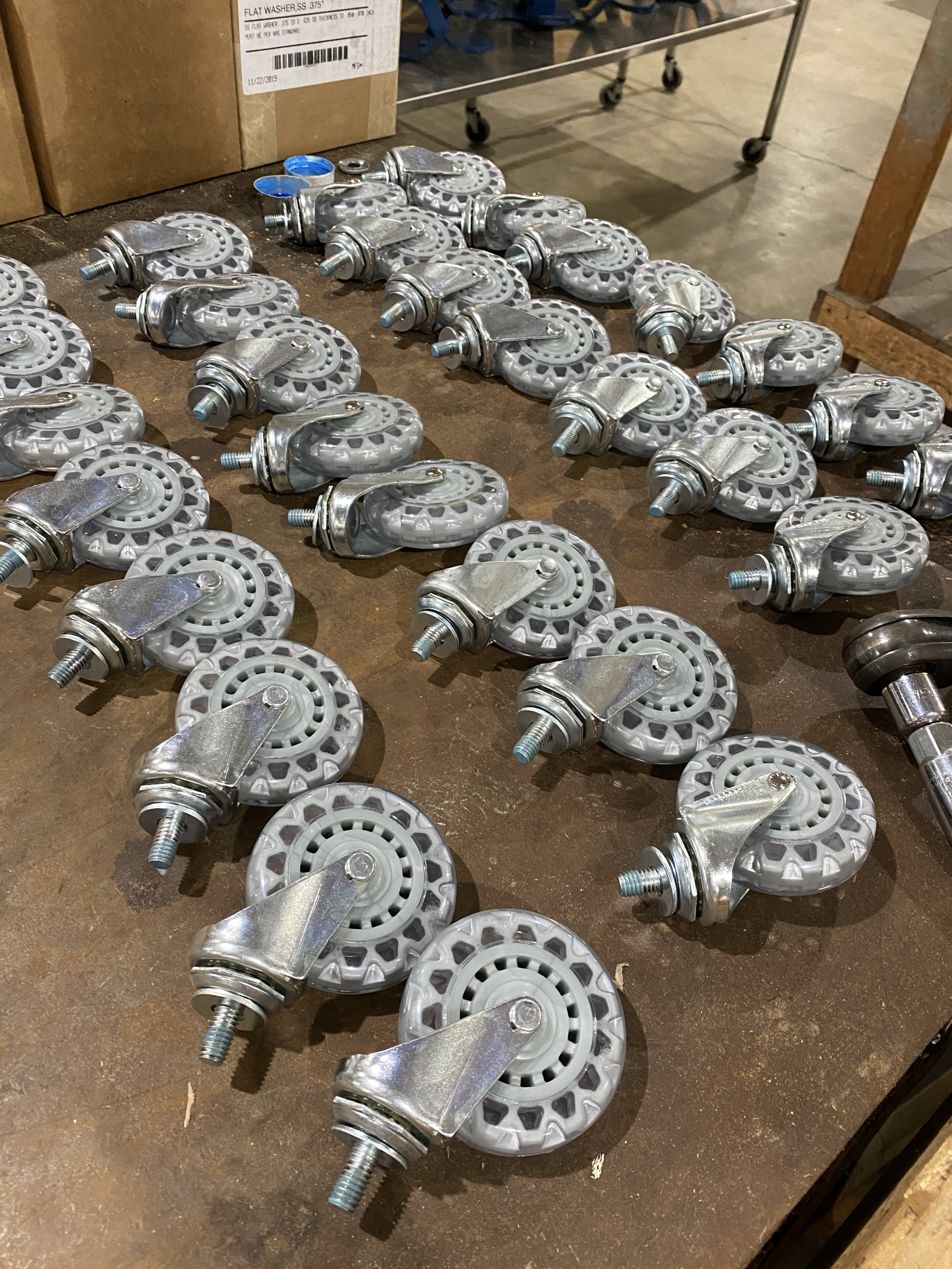
Caster Maintenance
Caster Selection
After careful evaluation, Blickman has selected the best casters for its equipment to meet the special needs of health care institutions worldwide.
Key considerations when selecting casters:
Load Weight and Wheel Size
Generally, the greater the load weight, the larger the caster. The right size caster will also allow equipment to roll more easily. By determining the maximum load and dividing it over the number of casters, you can determine the weight that each caster must support. Tables and stands that travel only short distances will operate efficiently with a 2″ or 3″ medium-duty caster with a weight load of 75 lbs. per caster. Blickman also utilizes 5″ medium and 6″ heavy duty casters with weight loads of 250-500 lbs. per caster for larger material handling and case carts. These will provide a smoother and quieter ride.
Wheel Bearings
For the majority of equipment, we have selected ball bearings for maximum rollability for loads up to 1200 lbs. However, Celcon® bearings are used in case carts and other applications where water and other liquids are present as well as varying temperature conditions. These bearings are made of Celanese® plastic and are highly durable, corrosion resistant and require minimum lubrication.
Operating Environment
We utilize rubber wheels on most of our equipment unless in the presence of corrosive materials or chemicals where polyurethane may be recommended. Thermoplastic rubber wheels protect the floors from scuffing and the softer wheel provides a quieter ride. However, the polyurethane wheel has a greater load capacity and moderate floor protection. We utilize heavy-duty casters in most of our hand-pushed, material-handling equipment; however, in many applications a medium- or light-medium-duty caster is appropriate.
Special Conditions
We recommend nickel-plated casters with Celcon® bearings and stainless-steel hardware for increased longevity. For very frequent washings or wet environments, stainless-steel casters are recommended. Grease seals should be provided to keep lubricant in, and dirt out, of the casters. Case carts, instrument carts and supply carts often utilize swivel locks to convert swivel casters to rigidity for easier steering; wheel brakes may be required to lock a wheel in place.
Caster Maintenance Guide
Lubrication – Regular lubrication adds to the life of the wheel and swivel bearings and improves rollability. Normal conditions may require lubrication every six months; once a month in wet or corrosive environments.
Wheels:
Wheels should be checked for visible tread wear. Flat spots due to accumulation of material, such as string or thread, can cause the wheel to bind. The axle bolt and nut should be removed and the foreign material removed. If internal components are intact the caster can be reassembled. Thread guards are available if the problem persists.
Rubber tires can get badly worn and cause erratic steering, bumping, load shifting and floor damage. Replacement wheels and bearings should be kept on hand to keep equipment in work; reducing downtime.
Casters and Brakes:
For swivel casters, if the caster has excessive play due to wear, it may need replacement. If it does not turn freely; corrosion or dirt may also force their replacement.
Check brakes and locks for proper position. Check each brake separately to see that it is not slipping or loose. If slipping is due to worn wheels, replace wheels immediately. If the brake is not operating properly, repair or replace and retest before returning equipment to use.
If equipment is regularly maintained and not abused, you will get the maximum safety and service performance from your casters.